
DevOps
Streamlined development and operations processes that enable faster delivery, improved collaboration, and enhanced quality of software solutions.
Accelerate Delivery with DevOps
Our DevOps solutions help you break down silos, automate processes, and deliver high-quality software faster and more reliably.
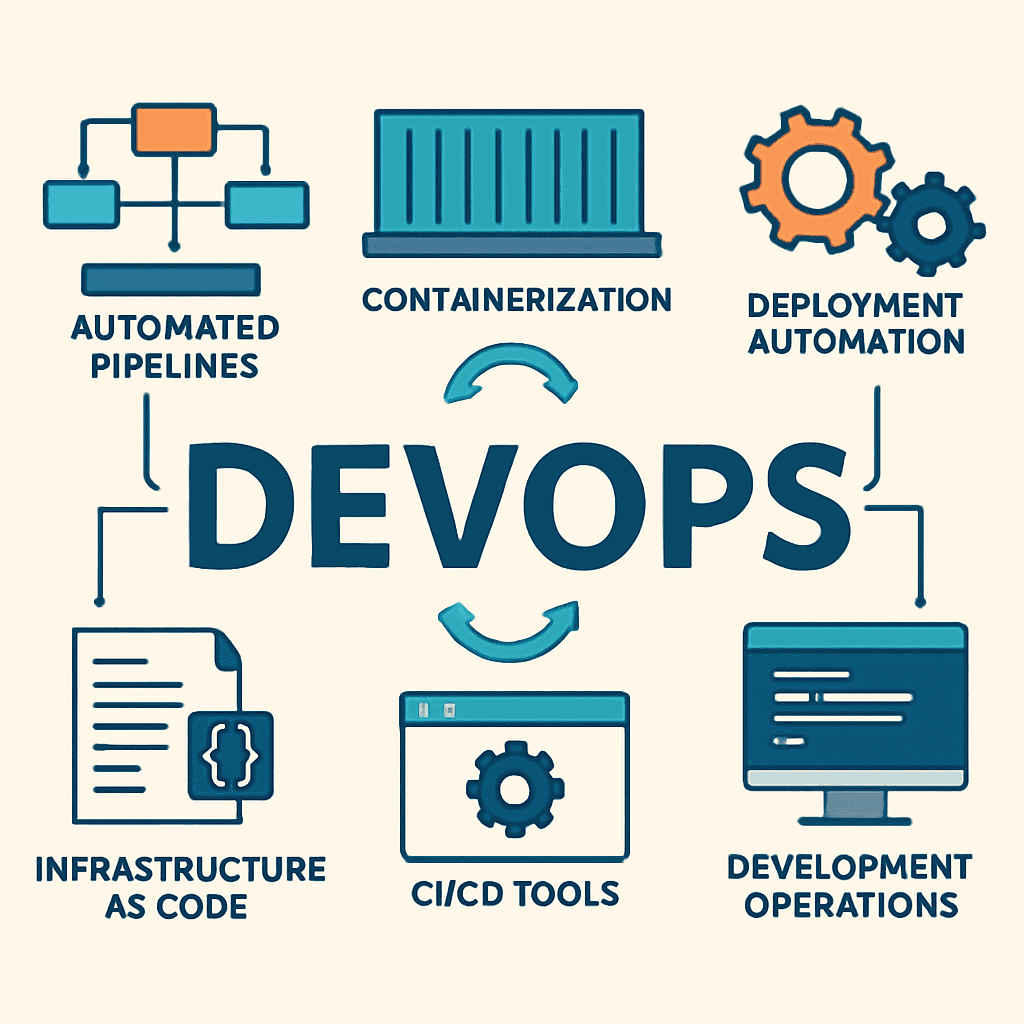
DevOps Solutions
Our comprehensive suite of DevOps services and technologies
- Continuous integration pipelines
- Automated testing frameworks
- Continuous delivery workflows
- Release management
- Infrastructure automation
- Configuration management
- Environment provisioning
- Version-controlled infrastructure
- DevOps maturity assessment
- Process optimization
- Team collaboration frameworks
- Cultural transformation
- Performance testing
- Scalability planning
- Resource optimization
- Bottleneck identification
- Security automation
- Vulnerability scanning
- Compliance as code
- Secure CI/CD pipelines
- Metrics collection
- Log aggregation
- Distributed tracing
- Alerting and incident management
DevOps Lifecycle
Understanding the continuous cycle of DevOps practices
Plan
Define requirements, plan features, and organize work using agile methodologies.
Code
Write code, use version control, and conduct code reviews.
Build
Compile code, run automated tests, and create deployable artifacts.
Test
Conduct automated testing, including unit, integration, and performance tests.
Deploy
Automatically deploy code to production or staging environments.
Operate
Manage infrastructure, configure systems, and ensure availability.
Monitor
Track performance, collect feedback, and identify areas for improvement.
DevOps Technologies
The tools and frameworks we use to implement DevOps practices
- Jenkins
- GitLab CI
- GitHub Actions
- CircleCI
- Azure DevOps
- ArgoCD
- Terraform
- Ansible
- Puppet
- Chef
- CloudFormation
- Pulumi
- Docker
- Kubernetes
- Helm
- OpenShift
- Istio
- Podman
- Prometheus
- Grafana
- ELK Stack
- Datadog
- New Relic
- Dynatrace
DevOps Implementation Process
Our proven methodology for successful DevOps transformations
Assessment & Strategy
Evaluate your current state and define your DevOps strategy.
Foundation Building
Establish the foundational elements of your DevOps practice.
Process Optimization
Streamline and automate your development and operations processes.
Cultural Transformation
Foster a culture of collaboration, experimentation, and continuous improvement.
Scaling & Optimization
Scale your DevOps practices across the organization and continuously improve.
Benefits of DevOps
How DevOps creates value for your business
Accelerate time-to-market with automated build, test, and deployment processes that enable frequent releases.
Improve software quality through automated testing, continuous integration, and early detection of issues.
Break down silos between development, operations, and other teams to foster a culture of shared responsibility.
Enhance system stability and reliability through infrastructure as code, monitoring, and automated recovery.
DevOps Success Stories
How our DevOps solutions have transformed businesses
E-commerce Platform DevOps Transformation
Implemented a comprehensive DevOps solution for an e-commerce platform, enabling continuous delivery, infrastructure automation, and improved collaboration.
Results:
75% reduction in deployment time
Financial Services CI/CD Implementation
Developed a secure CI/CD pipeline for a financial services company, enabling frequent releases while maintaining strict security and compliance requirements.
Results:
90% increase in deployment frequency
Healthcare DevSecOps Transformation
Created a DevSecOps framework for a healthcare provider that integrated security into every stage of the software delivery lifecycle.
Results:
60% reduction in security vulnerabilities
Frequently Asked Questions
Common questions about DevOps
DevOps is a set of practices, cultural philosophies, and tools that combines software development (Dev) and IT operations (Ops) to shorten the systems development life cycle while delivering features, fixes, and updates frequently, reliably, and at scale.
DevOps benefits your business by accelerating time-to-market, improving product quality, increasing operational efficiency, enhancing collaboration between teams, reducing costs through automation, and enabling faster response to customer feedback and market changes.
The timeline for DevOps implementation varies based on your organization's size, complexity, and current maturity level. Initial improvements can be seen within weeks, but a full transformation typically takes 6-18 months. We recommend a phased approach, focusing on high-value areas first and gradually expanding.
No, DevOps principles and practices can benefit any organization that develops or maintains software, regardless of industry. While software companies were early adopters, organizations in finance, healthcare, retail, manufacturing, and other sectors now leverage DevOps to improve their software delivery and operations.
DevOps and Agile are complementary approaches. Agile focuses on iterative development and collaboration between business and development teams, while DevOps extends these principles to include operations and the entire software delivery lifecycle. Together, they enable organizations to deliver value quickly, reliably, and sustainably.
CI/CD (Continuous Integration/Continuous Delivery) is a set of practices within the broader DevOps approach. CI/CD focuses specifically on automating the build, test, and deployment processes, while DevOps encompasses a wider range of practices including infrastructure automation, monitoring, security, and cultural transformation.
Ready to transform your software delivery with DevOps?
Schedule a consultation with our DevOps experts to discuss how our solutions can drive innovation and growth for your organization.