
Internet of Things (IoT)
Connected device ecosystems that generate valuable data and insights, enabling smarter decision-making and enhanced experiences.
Transform Your Business with IoT Solutions
Our IoT solutions connect your physical and digital worlds, delivering actionable insights and creating new opportunities for innovation.
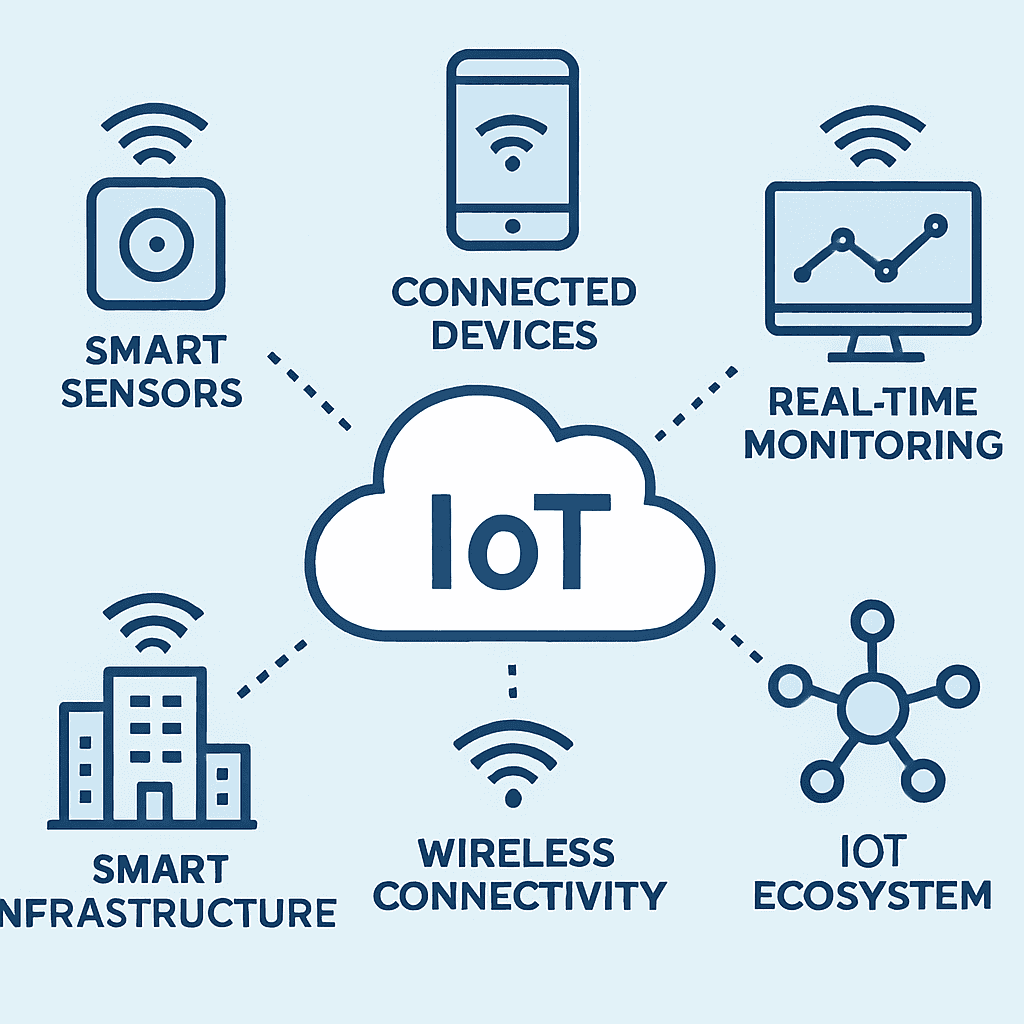
IoT Solutions
Our comprehensive suite of IoT services and technologies
- IoT readiness assessment
- Use case identification
- ROI analysis
- Implementation roadmap
- Device management
- Data collection and processing
- Analytics and visualization
- Integration with existing systems
- Product design and prototyping
- Embedded systems development
- Connectivity solutions
- User experience design
- Real-time data processing
- Predictive analytics
- Machine learning integration
- Custom dashboards and reporting
- Device security
- Network security
- Data protection
- Security monitoring and response
- 24/7 monitoring and management
- Performance optimization
- Security updates
- Continuous improvement
IoT Architecture
Understanding the components of an IoT ecosystem
Devices & Sensors
Physical hardware that collects data from the environment or performs actions based on commands.
Connectivity
Communication protocols and networks that enable devices to transmit data to the cloud.
Edge Computing
Local processing of data to reduce latency and bandwidth requirements.
Cloud Platform
Scalable infrastructure for data storage, processing, and analytics.
Analytics & AI
Tools and algorithms that transform raw data into actionable insights.
Applications
User interfaces and business systems that leverage IoT data and capabilities.
Cloud Platform
Edge Gateway
Edge Gateway
Edge Gateway
Industry Applications
How IoT technology is transforming various industries
Manufacturing
IoT enables smart factories with real-time monitoring, predictive maintenance, and automated quality control, improving efficiency and reducing downtime.
Healthcare
IoT transforms healthcare through remote patient monitoring, smart medical devices, and optimized hospital operations, enhancing patient care and reducing costs.
Smart Cities
IoT powers smart cities with connected infrastructure, efficient resource management, and enhanced public services, improving quality of life for citizens.
Retail
IoT revolutionizes retail through inventory tracking, personalized shopping experiences, and optimized store operations, increasing sales and customer satisfaction.
IoT Implementation Process
Our proven methodology for successful IoT deployments
Discovery & Strategy
Understanding your business needs and defining the IoT strategy.
Architecture & Design
Designing the technical architecture for your IoT solution.
Development & Integration
Building and integrating the components of your IoT solution.
Testing & Validation
Ensuring your IoT solution works reliably and securely.
Deployment & Scaling
Rolling out your IoT solution at scale.
Monitoring & Optimization
Continuously improving your IoT solution.
Benefits of IoT Technology
How IoT creates value for your business
Optimize processes, reduce waste, and improve resource utilization through real-time monitoring and automation.
Gain valuable insights from IoT data to make better business decisions and identify new opportunities.
Anticipate issues before they occur, enabling proactive maintenance and preventing costly downtime.
Create better customer and employee experiences through personalization and improved service delivery.
IoT Success Stories
How our IoT solutions have transformed businesses
Smart Manufacturing Transformation
Implemented an IoT solution for a manufacturing company that enabled predictive maintenance, reducing downtime and improving overall equipment effectiveness.
Results:
35% reduction in unplanned downtime
Connected Healthcare Solution
Developed a remote patient monitoring system for a healthcare provider, enabling continuous monitoring of vital signs and early intervention for at-risk patients.
Results:
22% reduction in hospital readmissions
Smart Retail Experience
Created an IoT-powered retail solution that provided real-time inventory visibility, personalized customer experiences, and optimized store operations.
Results:
18% increase in sales conversion
Frequently Asked Questions
Common questions about IoT technology
The Internet of Things (IoT) refers to the network of physical objects—'things'—embedded with sensors, software, and other technologies to connect and exchange data with other devices and systems over the internet. These devices range from ordinary household objects to sophisticated industrial tools.
IoT can benefit your business in multiple ways: improving operational efficiency through automation and real-time monitoring, enabling data-driven decision making, creating new revenue streams through connected products and services, enhancing customer experiences, and reducing costs through predictive maintenance and resource optimization.
IoT security is a critical consideration. When properly implemented with security best practices—including device authentication, encryption, secure boot, regular updates, and comprehensive monitoring—IoT systems can be secure. Our approach includes security by design, ensuring protection at every layer of the IoT stack.
Getting started with IoT typically involves identifying high-value use cases, conducting a proof of concept, and then scaling based on results. We recommend beginning with a strategic assessment to identify opportunities, followed by a small-scale pilot to validate the approach before full-scale implementation.
IoT devices can connect using various technologies, including Wi-Fi, Bluetooth, cellular (4G/5G), LPWAN (LoRaWAN, Sigfox), Zigbee, and more. The choice depends on factors like range requirements, power consumption, bandwidth needs, and deployment environment. We help select the optimal connectivity solution for your specific use case.
Managing IoT data involves a combination of edge computing (processing data close to the source), cloud storage and processing, and data lifecycle management. We implement data architectures that balance real-time processing needs with long-term storage and analytics, ensuring you can extract maximum value from your IoT data.
Ready to transform your business with IoT technology?
Schedule a consultation with our IoT experts to discuss how our solutions can drive innovation and growth for your organization.